Why Your Electric Bill Keeps Rising
If you’ve been looking for a way to save money on your electricity bills, solar panels can be an excellent addition to your home. Solar panels not only help reduce your energy costs but also benefit the environment.
Sunlight provides pure, renewable energy. It’s available to us whenever the sun shines, and it’s also among the cleanest energy sources on the planet.
Solar panels have been growing in popularity for some time. Many homeowners are seeing the benefits of solar power and choosing to invest in solar panels for their homes. More and more people are discovering that solar panels can help lower energy costs and reduce our impact on the environment, but not a lot of people know exactly how solar technology functions.
So, how do solar panels work? In this guide, we’ll be discussing the scientific process by which solar panels can take in energy from the sun and turn it into electricity that you can use in your home. We’ll tell you what solar panels are made of, how they work, and we’ll explain how much you can expect to spend on your own panels.
What are solar panels?
Solar panels transform light from the sun into usable energy through photovoltaic (PV) technology. Solar photovoltaic panels consist of a sheet of PV cells, a metal frame, a glass cover, and wiring.
One solar panel will contain many (usually 60-plus) PV cells configured in the shape of a square or rectangle. The more PV cells a panel has, the more energy it will be able to create. Solar panels are situated on a base structure that is bolted onto the roof of a home.
Every PV cell has two pieces of silicon (one on top of the other) that act as a semiconductor. To create an electrical field, the two pieces of silicon must have opposite electrical charges.
The silicone piece on top has been doped (infused) with phosphorus. The phosphorus adds electrons to the composition of the silicon piece, giving it a negative charge. The bottom piece of silicon has been doped with boron. The boron molecules decrease the amount of electrons in the silicon, giving the silicon a positive charge.
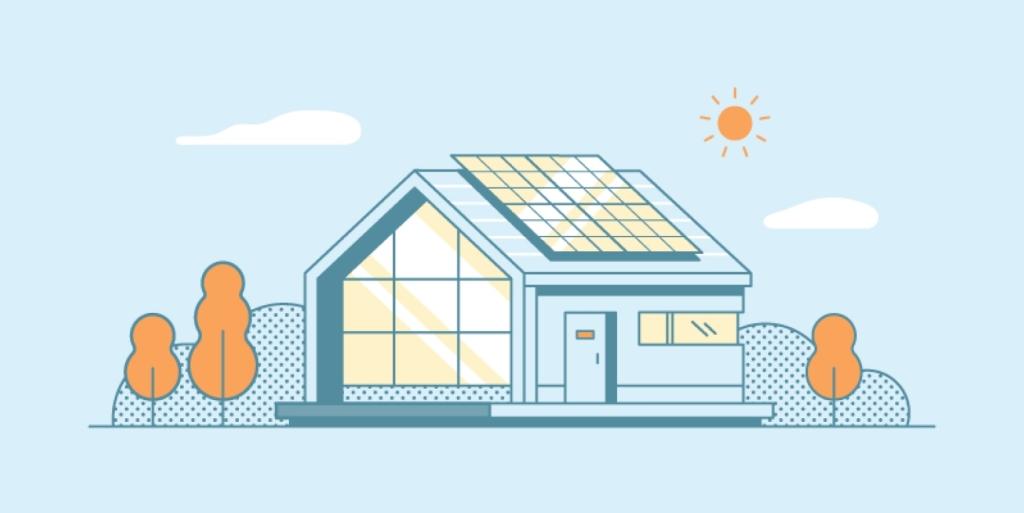
How solar cells work
Now that you know what PV panels are made of, you might be wondering how they can transform the sun’s rays into useful energy. The process by which solar panels produce electricity out of sunlight is called the photovoltaic effect. Here’s how it works.
Sunlight interacts with the solar panel and enters the PV cells. When light goes into a PV cell, photons (light energy particles) pass through the top, negatively charged silicon layer. When the photons reach the lower, positively charged silicon layer, their energy is transferred to electrons.
This causes the electrons in the lower layer to launch themselves into the upper layer. The electrons start to circulate and create an electric current. The upper silicone layer then sends the electrons through a circuit in the form of electricity.
How home solar panels work
Homeowners attach solar photovoltaic panels to their roofs to harness energy from the sun and fuel the appliances and systems in their homes. Typically, a solar panel installer gives the homeowner advice like which direction and what angle to position their panels for maximum energy production. In the United States, for example, solar panels should ideally face south.
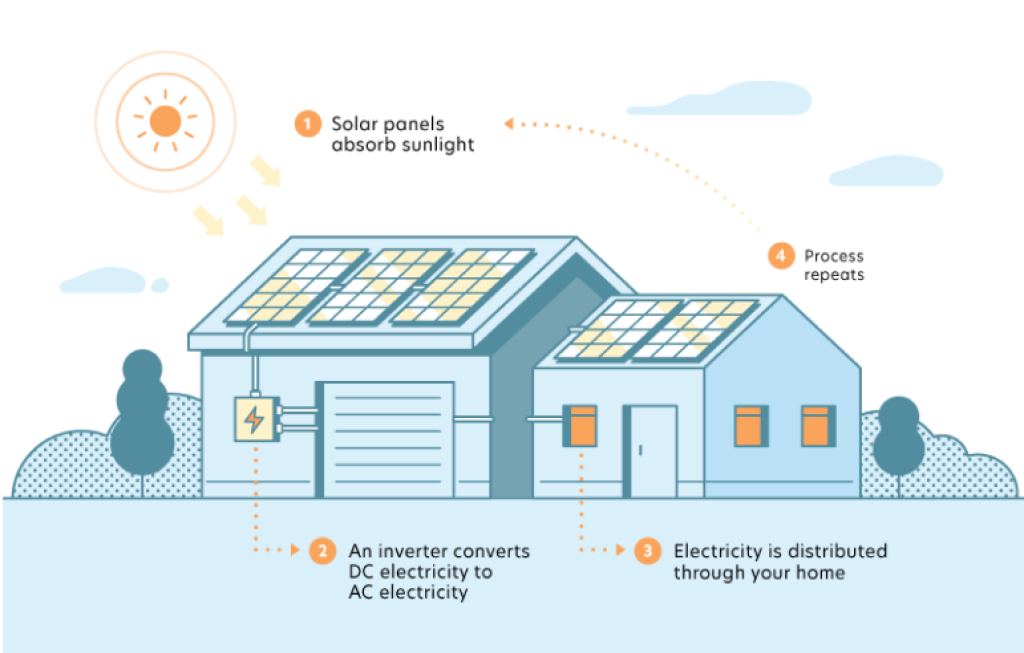
As we’ve already mentioned, each panel contains a sheet of photovoltaic cells to absorb sunlight and change it into electricity. But before the newly created electricity can be used in a home, it still needs to be changed from direct current (DC) electricity to alternating current (AC) electricity.
The device responsible for changing energy from DC electricity to AC electricity is called an inverter. Most solar energy systems won’t have more than one or two inverters, depending on the size of a home. Homeowners can also purchase microinverters that fasten to every panel in a system to increase the amount of electricity a system can produce.
After changing the electricity into AC electricity, the inverter sends the energy through a circuit to your breaker box. From there, the electricity is distributed to all your home appliances and systems.
While there are off-grid solar energy systems, most homes with solar panels still stay connected to their utility company’s electrical grid. The reason for this is that the amount of energy that solar panels can generate is dependent on the weather.
While solar panels still produce electricity on cloudy days, they won’t create nearly as much power as they could on a sunny day. There might be days when panels can’t create enough electricity to power a home efficiently. On those days, homeowners can still use power from their utility company.
There might be other times that a system produces more energy than a home needs. In these situations, the excess energy will flow back through the utility company’s power grid so that it can be distributed among consumers in the area. This process is called net metering. Generally, utility companies offer credits to solar energy users who share their extra energy.
How many solar panels does your home need?
The amount of solar panels that you need will depend on factors like how large your roof is and the volume of energy you want to produce. On average, a home solar energy system will have around 20 to 25 panels.
When you reach out to SolarAmerica, we’ll connect you with a specialist who can survey your property and tell you exactly how many solar panels you need.
How much do solar panels cost?
There’s a lot of different variables that can affect the cost of home solar panels. The number of solar panels you’ll need, how much energy you want to create, the size and design of your panels, and any upgrades like microinverters can all affect the total price of your solar energy system.
While solar panels can save you money in the long run, they can require a substantial initial investment. Beyond the price of your panels themselves, you may also have to pay for things like state and local permits and installation.
Before you start planning out your solar energy system, you should have a ballpark of what your panels will cost you. A SolarAmerica specialist will work with you to create a quote for a system that meets your energy needs. They’ll also share information about financing plans that can help make going solar more affordable.
How long do solar panels last?
On average, solar panels last around 25 to 30 years. However, you might need to replace other equipment in your system more often. For example, solar inverters usually only last around 10 to 15 years.
You may also have a battery for your solar panel system that allows you to store energy from the sun for later use. The life span of a solar battery will depend on how often you use it. If you only use a battery during an emergency, like a power outage, it can last well over 20 years. But if you use it as your main power source, it might stop working in as little as 10 years.
Discover how SolarAmerica can help with your transition to a
smart home
Solar panels use the photovoltaic effect to capture sunlight and transform it into electricity you can use to power your home. And unlike fossil fuels, solar energy doesn’t release any greenhouse gas emissions, like carbon dioxide, into the atmosphere.
A solar energy system can be a great addition to your home whether you’re environmentally conscious or just looking to save money on your utility bill over time. Solar panels can even increase the market value of your home and help you score government tax incentives, like the solar investment tax credit (ITC).
If you’re thinking about investing in solar panels or other smart home upgrades, request a consultation from a SolarAmerica professional. Our experts can help you design your ideal smart home and security system, complete with smart products like lighting devices, sensors, locks, and cameras.
Five complete guides for going solar
Why Your Electric Bill Keeps Going Up
If it feels like your power bill climbs every year, that's because it usually does. Utility rates rise to cover aging grid infrastructure, fuel-cost swings, storm hardening, and surging electricity demand — and once a rate increase is approved, you have no way to opt out. You simply pay more for the same power.
For homeowners served by utilities like PECO, PPL, and Duquesne Light in Pennsylvania; Eversource and National Grid across Massachusetts and Rhode Island; PSE&G in New Jersey; Con Edison and RG&E in New York; BGE and Pepco in Maryland; and DTE, Consumers, AEP, FirstEnergy, and Duke across Michigan and Ohio, those increases stack up year after year — with no ceiling and nothing you can do to lock them down.
The Northeast Pays the Most
Residential electricity in the Northeast — Massachusetts, Rhode Island, New Jersey, New York, and Pennsylvania — is among the most expensive in the country. Higher starting rates mean every annual increase costs you more in real dollars, which is exactly why solar tends to "pencil out" faster in these states than almost anywhere else.
How $0-Down Solar Locks In Lower Power
Here's the core idea: every kilowatt-hour your roof produces is one you no longer buy from the utility at its rising rate. With a $0-down solar lease or PPA, you pay a per-kWh rate for your solar power that is often lower than your utility's — and far more predictable. No purchase. No loan. No large upfront cost.
Instead of being exposed to unpredictable utility hikes, you lock in a known rate for the power your own roof generates. Pair it with battery storage and you also keep the lights on during outages. The federal residential solar tax credit ended for property placed in service after December 31, 2025; incentive availability depends on ownership structure, state programs, and current law. SolarAmerica does not provide tax advice.
What You Can Do About It
The first step is simply to see whether solar makes sense for your home and what your numbers look like. SolarAmerica runs a free, 2-minute eligibility check, designs a system around your actual usage, and handles permits and installation through vetted local pros. As a Top Solar Contractor ranked #1 by Solar Power World with more than 20,000 installations, we make going solar straightforward — and there's no obligation. See solar in your state →
Lock in lower power than your utility
Utility rates climb almost every year. With $0-down solar you pay a lower, more predictable per-kWh rate — no purchase, no loan. See your savings in about 2 minutes. Free, no obligation.
Check My Savings →Rising Energy Costs — FAQ
Why does my electric bill keep going up?
Utilities raise rates to cover grid upgrades, fuel costs, storm hardening, and rising demand. Once a rate hike is approved you can't opt out — you pay more for the same electricity. Generating your own solar power is one of the few ways to reduce your exposure to those increases.
Can solar really cost less than my utility?
Often, yes. With a $0-down lease or PPA, many homeowners pay a lower, more predictable per-kWh rate for their solar power than their utility charges — and avoid future rate hikes on the power their roof produces. Actual savings vary by home, usage, and utility; SolarAmerica builds a custom estimate for you.
Is $0-down solar real?
Yes. SolarAmerica offers $0-down solar lease and PPA options for qualified homeowners — no purchase and no loan required — so you can start saving without a large upfront cost.
Which states have the highest electric rates?
The Northeast — including Massachusetts, Rhode Island, New Jersey, New York, and Pennsylvania — consistently has some of the highest residential electricity rates in the continental U.S., which is why solar value is especially strong there.
Receive a quote from SolarAmerica today